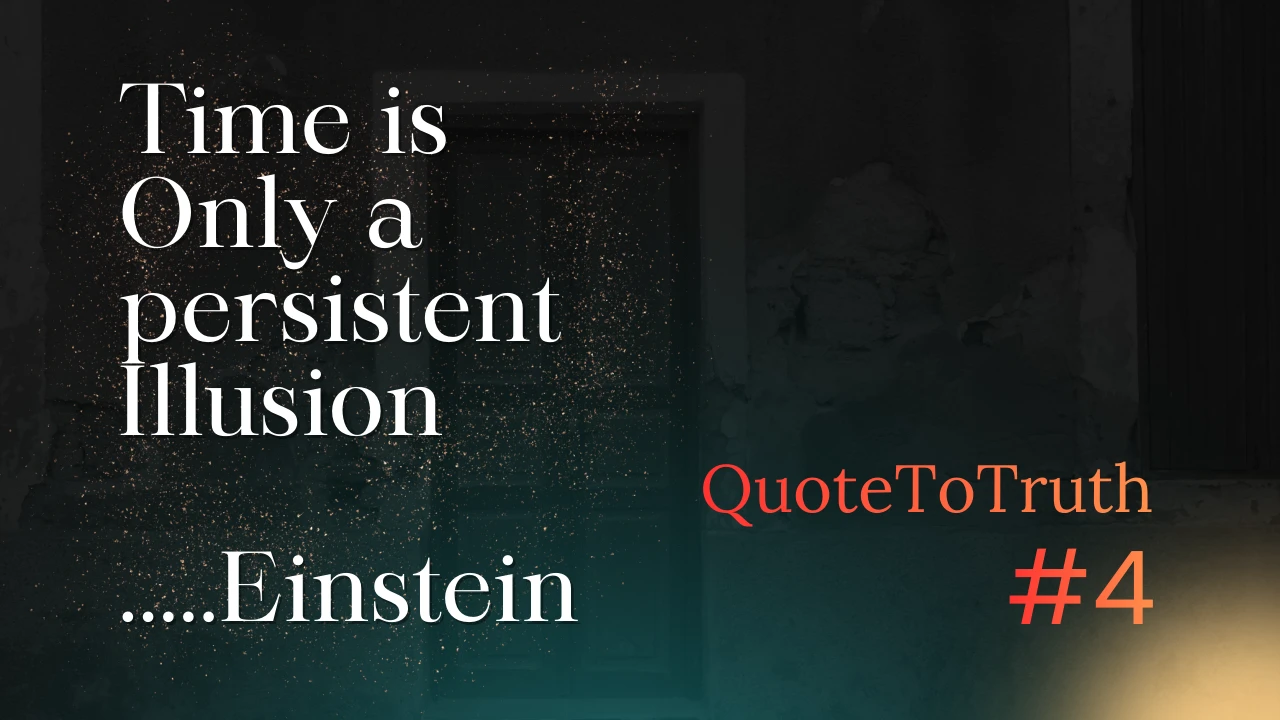

“People like us, who believe in physics, know that the distinction between past, present and future is only a stubbornly persistent illusion.”
— Albert Einstein, letter to the family of Michele Besso (March 21, 1955)
Q: What exactly did Einstein mean by calling time an illusion?
He meant that the experience of time flowing, past behind us, future ahead of us, present as a moving point, is not how reality is structured. His own Theory of Relativity had already demonstrated that time is not absolute. It flows differently depending on speed and gravity. A clock on a spaceship travelling near light speed ticks slower than a clock on Earth. Astronauts moving fast enough age more slowly than the people they left behind. If time were a fixed, universal river flowing at one rate for everyone, none of this would be possible.
Einstein understood that if time changes depending on who is observing and how they are moving, then the neat division of reality into past, present, and future cannot be fundamental. It is something the observer experiences, not something the universe enforces.
Q: In the previous articles, we discussed that the brain is a receiver, that there is only one mind, and that every being is geared into the universal mechanism. How does this connect?
Directly and deeply. If the brain is a receiver and not the origin of consciousness, and if the entire universe is one awareness appearing as many, then the question becomes: what is the nature of the reality that this one awareness is experiencing? Einstein’s insight about time gives us a crucial piece of that answer.
The experience of time, the feeling that moments pass, that the past is gone and the future has not yet arrived, is part of the rendered experience. It is how Source experiences its own simulation from within. Time is not a container that reality sits inside. Time is a feature of the experience itself.
Q: So is time not real at all?
Time is real as an experience. It is not real as a fundamental structure of existence.
As I explain in my book, Autography by Source: The Law of Everything, the universe is not a smoothly flowing continuum. It is a frame-by-frame rendering. Each moment is a distinct pulse of Source awareness, a fresh frame, complete in itself. When these frames are experienced in rapid sequence, they create the appearance of continuous time, space, and motion, exactly like frames in a film create the illusion of a moving picture.
But just as each frame in a film is a still image that contains no motion, each pulse of the simulation is a static configuration. Motion, change, the flow of time, all of these are perceived only by comparing one frame to the next. They do not exist inside any single frame.
This is precisely what Einstein was pointing to. The distinction between past, present, and future is an illusion because all of them are rendered frames within the same field of awareness. Source does not experience a “past” that is gone or a “future” that has not arrived. It pulses each frame fresh, in what we might call an eternal now.
Q: How does the frame-by-frame rendering actually work?
Each pulse from Source generates a complete configuration of everything that exists for that moment: every particle, every field, every object, every position, every state. This single frame is held in awareness for one Planck time, approximately 5.39 x 10^-44 seconds, the smallest meaningful unit of time in physics. Then the next frame is pulsed.
There is no “between” frames. There is simply Source pulsing the next frame. Continuity, the smooth flow we experience as time, is created by this unimaginably rapid succession of pulses. And every frame is rendered fresh. Even objects that appear still are re-rendered entirely each frame. Nothing carries over automatically. Persistence is not inertia; it is continuous reaffirmation by Source.
This is why Planck time and Planck length exist in physics. They are not arbitrary limits. They are the resolution of the rendering: the minimum tick and the minimum pixel of the simulation.
Q: If time is rendered frame by frame, what explains time dilation? Why does time slow down for objects moving at high speed?
This is one of the most elegant confirmations of the frame-by-frame rendering truth.
Each node in the simulation has a fixed action budget per frame, governed by the Planck constant. Think of it as a coin you receive per frame. If the object is at rest, almost the full coin goes to internal evolution: the ticking of clocks, cellular processes, aging, atomic vibrations. But if the object is moving at high speed, a large portion of that coin is spent on updating its position frame by frame, leaving less for internal processes.
The result: a moving object’s internal processes slow down relative to a stationary observer. Its clocks tick slower. Its occupants age more slowly. This is time dilation. Einstein described it mathematically through relativity. The frame-by-frame simulation truth explains the mechanism behind it: the redistribution of a fixed action budget per pulse.
Q: Does this mean Einstein was essentially describing a simulated universe without using that word?
Einstein went as far as his framework allowed. Relativity showed him that time and space are not fixed, that they warp and bend, that the neat separation of past, present, and future is not real. He saw the evidence clearly enough to state it plainly in a personal letter at the end of his life.
What Einstein could not formalize, because the language and framework did not exist in his time, I have laid out in Autography by Source. The universe is not a collection of objects moving through time and space. It is a rendered simulation, pulsed frame by frame by a singular Source awareness. Time is not flowing. It is being generated, pulse by pulse, as the structure through which Source experiences sequence, contrast, and meaning. Without frame-by-frame rendering, there would be no before and after, no cause and effect, no experience at all. Just undifferentiated stillness.
Q: If there is no real past or future, what does that mean for how we live?
It means the present frame is all that exists. Not as a motivational slogan, but as the literal architecture of reality.
The past is not stored somewhere behind you. The future is not waiting ahead. Both are rendered frames. What you call memory is not a retrieval from some physical archive. It is coherence re-entry: the brain locking back into a pattern that already exists in the field of awareness. And what you call anticipation is the projection of a potential frame that has not yet been pulsed.
The only point of power, the only point where anything actually happens, is this frame. Right now. This pulse. Source is not dwelling in the past or planning for the future. It is pulsing this moment, fresh and complete. And you are that pulse.
Einstein said it at the end of his life, writing to comfort a grieving family. The distinction between past, present, and future is only a stubbornly persistent illusion. He was right. And now we know exactly why.
Want to understand the complete mechanism, how Source pulses reality frame by frame through the Quantum Potential Field, how the Source Pulse Particle Lattice renders space and time at Planck resolution, how time dilation and every relativistic effect emerges from this architecture, and how the entire system from Source to classical reality operates? Explore the LifeEngineering course, based on my book Autography by Source: The Law of Everything.