
Diversity and the Living World
Learning Objectives
- Appreciate the extraordinary diversity of living organisms across different habitats on Earth
- Understand how early human societies viewed both inanimate matter and living organisms with a sense of awe
- Explain why anthropocentric thinking limited progress in biological knowledge
- Describe how the need to organise millions of life forms led to systems of identification, nomenclature, and classification
- Recognise that all living organisms on Earth are related to one another, past and present
- Outline Ernst Mayr's key contributions to evolutionary biology, taxonomy, and the biological species concept
- Distinguish between the technical and philosophical dimensions of the question 'What is life?'
Diversity and the Living World
Have you ever paused to wonder why a seahorse looks so different from a sunflower, yet both are equally “alive”? Biology is the science of life forms and living processes, and the living world it studies is full of surprises like this. Organisms survive in cold mountain peaks, deciduous forests, oceans, fresh water lakes, scorching deserts, boiling hot springs, the pitch-dark ocean floor, and everything in between. Before we can study biology in any organized way, we need to step back and ask some very basic questions: what counts as living? How did humans first begin to make sense of this incredible variety? And why did scientists feel the need to build vast systems for naming and sorting millions of life forms?
This topic sets the stage for all of Unit 1 by exploring these foundational questions.
From Awe to Understanding: How Humans First Looked at the Natural World
Long before microscopes or laboratories existed, people noticed that the world around them could be split into two broad categories: things that move, grow, and respond on their own, and things that do not. Early human societies could tell living organisms apart from non-living matter without any scientific training.
But here is the interesting part: both categories inspired awe and even fear. Powerful forces of nature like wind, the sea, and fire were often worshipped as gods or divine forces, even though they are not alive. At the same time, certain animals and plants were also treated as sacred. The common thread was the overwhelming feeling these phenomena created in people, not whether they were biologically alive.
Detailed, scientific descriptions of living organisms, including humans themselves, came much later in history. For a long time, many societies looked at biology through a lens focused almost entirely on humans. This anthropocentric (human-centred) way of thinking put people at the centre of everything and paid little attention to other organisms. The result? Very slow progress in understanding the true scope of life on Earth.
Why Classification Became Essential
As people began to explore and describe more and more organisms, the sheer number became overwhelming. Scientists realized they needed organized systems to handle this flood of information. Out of sheer necessity, three powerful tools were developed:
- Identification — figuring out what an organism is and whether it has already been described
- Nomenclature (the formal system of naming) — giving each organism a standardized name that scientists across the world could agree on
- Classification — grouping organisms based on shared features so that patterns and relationships become visible
These were not invented for their own sake. They grew out of a practical need to bring order to the enormous variety of life being discovered around the globe.
The Biggest Discovery: All Life Is Connected
The most profound outcome of all this careful cataloguing was not just a tidy filing system. It was a deep insight: living organisms share similarities in two important directions.
- Horizontally — organisms living at the same point in time share features with one another. A frog and a fish, both alive today, share certain body-plan characteristics despite looking very different.
- Vertically — organisms share features with their ancestors across evolutionary time. The bones in a whale’s flipper, a bat’s wing, and a human arm all trace back to a common ancestral limb structure.
Taken together, these horizontal and vertical similarities led to one of the most humbling realizations in all of science: every organism alive today is related to every other living organism, and also to every organism that has ever lived on this planet. This understanding did not stay locked inside laboratories. It spread into culture and society, inspiring worldwide movements to conserve biodiversity (the full variety of life forms on Earth).
Ernst Mayr: The Darwin of the 20th Century
One scientist who shaped our modern understanding of biological diversity more than almost anyone else was Ernst Mayr (1904-2004).
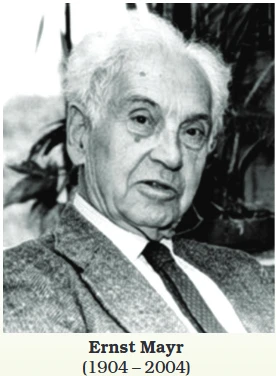
Mayr was born on 5 July 1904 in Kempten, Germany. He joined Harvard University’s Faculty of Arts and Sciences in 1953 and stayed there until his retirement in 1975, when he took the title of Alexander Agassiz Professor of Zoology Emeritus (an honorary title given to distinguished retiring professors).
Over a career spanning nearly 80 years, Mayr worked across an extraordinary range of fields:
- Ornithology (the study of birds)
- Taxonomy (the science of classifying organisms)
- Zoogeography (how animal species are distributed across the globe)
- Evolution
- Systematics (the study of relationships among organisms)
- History and philosophy of biology
Two of his contributions stand out above all others:
- He almost single-handedly turned the origin of species diversity into the central question of evolutionary biology. Before Mayr, this question was not given the priority it deserved.
- He pioneered the currently accepted definition of a biological species, which remains the standard used by biologists today.
In recognition of this extraordinary body of work, Mayr received the three prizes that are widely considered the triple crown of biology:
| Prize | Year Awarded |
|---|---|
| Balzan Prize | 1983 |
| International Prize for Biology | 1994 |
| Crafoord Prize | 1999 |
Mayr died in 2004 at the age of 100, having been recognized as one of the 100 greatest scientists of all time.
The Central Question: What Does It Mean to Be Living?
Picture a galloping horse, migrating birds crossing an ocean, a valley carpeted with wildflowers, or a shark cutting through the water. Each of these scenes fills us with wonder. But when you look closer, the living world is impressive at every scale: members of a population compete and cooperate, populations within a community interact in complex ways, and even inside a single cell, molecules carry out traffic that is staggeringly well-organized.
All of this leads to one big question: what, exactly, is life?
This seemingly simple question actually hides two very different sub-questions:
- The technical question — What makes something “living” as opposed to “non-living”? What features or processes define life?
- The philosophical question — What is the purpose of life? Why does life exist at all?
As biologists, the focus is squarely on the first question. Science deals with what can be observed, measured, and tested. The philosophical side, while fascinating, falls outside the scope of scientific investigation.
So the real starting point for biology is this: what is living? The chapters that follow in this unit will begin to answer that question by exploring how organisms are identified, named, classified, and organized into groups that reveal the deep patterns of life on Earth, all from a taxonomist’s (a scientist who classifies organisms) perspective.