
Taxonomic Categories in Practice: From Kingdoms to Species
Learning Objectives
- Trace the complete taxonomic classification of man from Kingdom Animalia down to species Homo sapiens
- Trace the complete taxonomic classification of housefly from Kingdom Animalia to species Musca domestica
- Trace the complete taxonomic classification of mango from Division Angiospermae down to species Mangifera indica
- Trace the complete taxonomic classification of wheat from Division Angiospermae down to species Triticum aestivum
- Compare and contrast the classification paths of two animals (man and housefly) and two plants (mango and wheat)
- Recognise that the same hierarchy of seven ranks applies uniformly to every organism, whether plant or animal
Taxonomic Categories in Practice: From Kingdoms to Species
You have spent the last few topics learning each rung of the taxonomic ladder: kingdom, phylum (or division), class, order, family, genus, and species. You know the rules, the definitions, and a handful of examples at each level. But here is the real test of understanding: can you take a familiar organism and trace its entire classification path from top to bottom? That is exactly what this topic does. We will walk through four everyday organisms (man, housefly, mango, and wheat) and place each one into all seven taxonomic ranks. Seeing the full picture for real organisms makes the abstract hierarchy feel concrete and usable.
The Hierarchy at a Glance
Before diving into specific organisms, recall the order of the seven obligatory ranks. The figure below shows them arranged from lowest to highest:
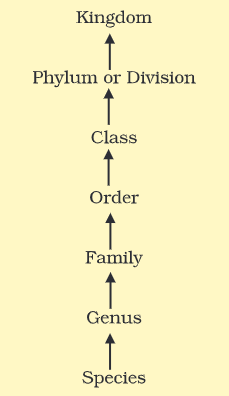
Fig 1.1: Taxonomic categories showing the hierarchical arrangement in ascending order
Every organism, no matter how simple or complex, is placed into each of these seven ranks. The path from kingdom to species narrows down step by step, with each lower rank representing a smaller, more closely related group.
Four Organisms, Seven Ranks Each
The table below (Table 1.1) lays out the complete classification for four common organisms: two animals and two plants. Take a moment to study it; the comparisons across columns are just as valuable as the individual paths.
| Common Name | Scientific Name | Genus | Family | Order | Class | Phylum / Division |
|---|---|---|---|---|---|---|
| Man | Homo sapiens | Homo | Hominidae | Primata | Mammalia | Chordata |
| Housefly | Musca domestica | Musca | Muscidae | Diptera | Insecta | Arthropoda |
| Mango | Mangifera indica | Mangifera | Anacardiaceae | Sapindales | Dicotyledonae | Angiospermae |
| Wheat | Triticum aestivum | Triticum | Poaceae | Poales | Monocotyledonae | Angiospermae |
All four organisms also belong to a kingdom: man and housefly fall under Kingdom Animalia, while mango and wheat fall under Kingdom Plantae.
Understanding the Terms
Several names in that table are worth pausing on:
- Hominidae — the family of great apes, which includes humans, chimpanzees, gorillas, and orangutans
- Muscidae — a large family of flies that includes the common housefly
- Anacardiaceae — the cashew or sumac family of flowering plants, to which mango belongs
- Poaceae — the grass family, one of the largest plant families on Earth, covering wheat, rice, maize, bamboo, and sugarcane
- Primata — the order containing primates: monkeys, apes, lemurs, and humans
- Diptera — the order of “two-winged” insects, covering all true flies, mosquitoes, and gnats
- Sapindales — a plant order that includes families producing fruits like mango, lychee, and citrus
- Poales — a plant order dominated by grasses, sedges, and related monocots
- Dicotyledonae — the class of flowering plants whose seeds have two seed leaves (cotyledons), such as mango, peas, and roses
- Monocotyledonae — the class of flowering plants whose seeds have a single seed leaf (cotyledon), such as wheat, rice, lilies, and onions
- Chordata — the animal phylum defined by the presence of a notochord and dorsal hollow neural system
- Arthropoda — the animal phylum whose members have jointed legs and an external skeleton (exoskeleton), including insects, spiders, and crabs
- Angiospermae — the division of seed plants that produce flowers and enclose their seeds inside fruits
Reading the Table: What the Comparisons Reveal
Animals: Man vs. Housefly
Man and housefly are both animals, so they share Kingdom Animalia. But that is where the similarities end. They split into different phyla right away:
- Man sits in Chordata (animals with a notochord), while housefly sits in Arthropoda (animals with jointed legs and an exoskeleton).
- From phylum downward, every single rank is different: different class (Mammalia vs. Insecta), different order (Primata vs. Diptera), different family (Hominidae vs. Muscidae), different genus, and different species.
This tells you that man and housefly are about as distantly related as two animals can be while still belonging to the same kingdom. The only rank they share is kingdom itself.
Plants: Mango vs. Wheat
Mango and wheat are both flowering plants, placing them in the same division, Angiospermae. They share one more level than man and housefly do. But they split at the class level:
- Mango falls into Dicotyledonae (seeds with two cotyledons), while wheat falls into Monocotyledonae (seeds with one cotyledon).
- Below class, every rank diverges: different order (Sapindales vs. Poales), different family (Anacardiaceae vs. Poaceae), different genus, and different species.
So while mango and wheat are more closely related to each other than man is to a housefly (they share both kingdom and division), they still take very different paths once you go below division.
The Broader Lesson
This comparison highlights a key principle you saw in earlier topics: the higher the rank where two organisms first come together, the more distantly related they are. Man and housefly only meet at the kingdom level, making them very distantly related. Mango and wheat meet at the division level, which is closer but still quite far apart. If two organisms shared the same family, they would be far more similar to each other than any pair in our table.