
Branches of Geography
Learning Objectives
- Distinguish between the systematic and regional approaches to studying geography
- Identify the scholars who introduced each approach and explain their core ideas
- List the main branches of physical geography and describe what each one studies
- List the main branches of human geography and explain their focus areas
- Explain why biogeography sits at the interface of physical and human geography
- Describe the methods and techniques used in modern geographical study
Branches of Geography
Geography does not operate as one big, undivided subject. Over time, it has grown into a tree with many branches, each focused on a particular aspect of the earth. Some branches study the physical world, others study human activity, and a few sit right at the meeting point of the two. Before looking at these branches, though, it helps to understand the two broad approaches that geographers use to organise their work.
Two Ways to Study Geography: Systematic and Regional
Geographers have long debated the best way to study the earth. Two broad approaches emerged, each championed by a German geographer in the 19th century.
The Systematic Approach
The systematic approach (also called general geography) was introduced by Alexander Von Humboldt (1769-1859). The idea is simple but powerful: pick one phenomenon and study it across the entire world before drawing any conclusions.
Say you want to understand natural vegetation. Using the systematic approach, you would first look at vegetation patterns globally. Then you would start spotting types and grouping them: equatorial rain forests in the tropics, softwood conical forests in the colder high latitudes, monsoon forests in seasonal rainfall zones, and so on. Each type gets identified, discussed, and mapped. The focus is on the phenomenon first, and the location second.
This approach works well for discovering global patterns and building general principles that apply everywhere.
The Regional Approach
The regional approach was developed by Karl Ritter (1779-1859), who was a contemporary of Humboldt. This approach flips the logic. Instead of starting with a single phenomenon and going global, you start with a region and study everything inside it.
The world gets divided into regions at different hierarchical levels (from large continental zones down to small local areas). These regions can be natural (based on physical features like climate or terrain), political (based on national or administrative boundaries), or designated (created for a specific research or planning purpose). Once a region is defined, all the geographical phenomena within it are studied together in a holistic manner. The goal is to find unity in diversity, to see how the different elements within a region connect and influence one another.
The Physical-Human Split: Dualism in Geography
Right from its early days, geography has displayed a quality known as dualism (the presence of two contrasting viewpoints within the same field). The most visible form of this dualism is the divide between physical geography and human geography.
Early geographers focused almost entirely on the natural world: rocks, rivers, weather patterns, and soil. Over time, however, it became clear that people are woven into the fabric of the earth. Humans depend on natural systems, alter them through farming, industry, and settlement, and layer their cultures, languages, and political structures on top of the physical landscape. This realisation gave rise to human geography, which places human activities and their spatial patterns at the centre of study.
Today, the branches of geography are organised along this divide, with a third group, biogeography, sitting at the interface where the physical and human sides meet.
Branches of Physical Geography
Physical geography deals with the natural features and processes of the earth. Its main branches are:
-
Geomorphology — Studies landforms: how mountains, valleys, plains, and plateaus form, how they change over time, and the processes (erosion, weathering, tectonic activity) that shape them.
-
Climatology — Deals with the atmosphere and the forces that drive weather and climate. It examines elements like temperature, pressure, humidity, and wind, classifies different climatic types, and maps out the climatic regions of the world.
-
Hydrology — Explores the world of water, from vast oceans and deep lakes to flowing rivers and underground aquifers. It looks at how water shapes landscapes, supports living organisms, and influences where and how people settle and carry out their economic activities.
-
Soil geography — Investigates what makes soils differ from place to place. It covers the processes that create soil, the major soil types, their fertility, and how different regions use their soils for agriculture and other purposes.
Branches of Human Geography
Human geography turns the lens onto people and the patterns their activities create across space:
-
Social and cultural geography — Studies how societies are structured in space, how they change over time, and the cultural elements (language, religion, customs, art) that different communities contribute to the landscape.
-
Population and settlement geography — Asks the big questions about people: how fast populations grow, where they cluster or thin out (distribution and density), what the sex ratio looks like, why people migrate, and what kinds of work they do (occupational structure). The settlement side looks at how villages and cities are laid out and what gives each type of settlement its distinctive character.
-
Economic geography — Looks at economic activities: agriculture, industry, tourism, trade, transport, infrastructure, and services. It asks where these activities happen, why they concentrate in certain places, and how they connect across space.
-
Historical geography — Looks backwards in time to understand how a region came to be what it is today. Every landscape carries the marks of past events, whether it is ancient trade routes shaping settlement patterns, colonial boundaries still visible on a modern map, or centuries of farming transforming a forest into farmland. By studying these historical layers, this branch connects the past to the present-day character of places.
-
Political geography — Examines how political decisions and events play out across space. It covers questions like where national and regional boundaries fall, how neighbouring states relate to each other, how election constituencies are mapped out, what voting patterns look like across different areas, and what drives the political behaviour of populations.
Biogeography: Where the Physical Meets the Human
Not everything in geography fits neatly into the physical or human category. The overlap between the two gave rise to biogeography, which studies living organisms and their relationship with the environment. Its branches include:
-
Plant geography (phytogeography) — Studies where different types of natural vegetation grow and the habitats that support them. It maps the spatial patterns of plant life across the earth.
-
Zoo geography — Turns the same lens on the animal world. It maps where different species live, identifies patterns in their distribution, and examines what geographic conditions make certain habitats suitable for certain animals.
-
Ecology and ecosystem studies — Studies how organisms live together in their environments. It looks at the web of relationships between species and the physical conditions of their habitats, building a picture of how ecosystems function at scales from a single pond to an entire biome.
-
Environmental geography — A newer branch that emerged as people around the world began recognising serious environmental problems. Issues such as land degradation (the decline in the quality and productivity of land), pollution, and the need for conservation drove the creation of this branch, which studies how human activities interact with and affect the natural environment.
The Tools of the Trade: Methods and Techniques
Beyond the content branches, geography also has its own set of methods and techniques that support research across all areas:
-
Cartography — The science and art of making maps. This is one of geography’s oldest tools.
-
Field survey methods — Techniques for collecting data directly from the ground through observation, measurement, and interviews.
-
Quantitative techniques — Statistical and mathematical methods used to analyse geographical data, identify patterns, and test theories.
-
Geo-informatics — A modern toolkit that brings together GIS (Geographic Information Systems, which store, analyse, and display spatial data), GPS (Global Positioning System, which pinpoints exact locations on the earth’s surface), and LIS (Land Information Systems, which manage data about land use and ownership).
The Philosophical Foundation
Geography also has a branch concerned with its own ideas and principles:
-
Geographical thought — Examines the theories, ideas, and philosophies that have guided how geographers study the world. Just as science has its philosophy of science, geography has its own intellectual tradition that shapes the questions it asks and the methods it uses.
-
Human ecology — Studies the interaction between land and human beings, exploring how people depend on, adapt to, and modify their environment. This sits within the principles and philosophy of the discipline because the land-human relationship is central to what geography is about.
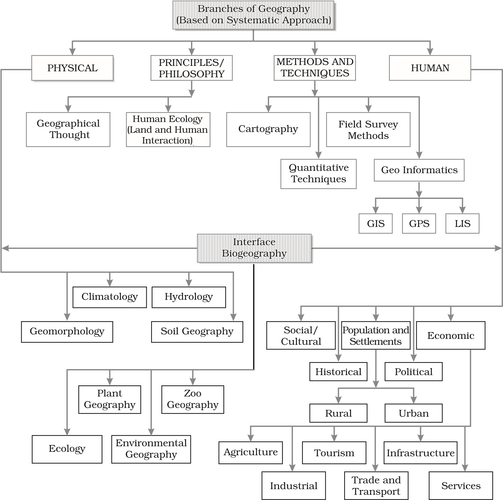
Fig 1.2: Branches of geography based on the systematic approach
Seeing the Full Picture
What stands out when you look at all these branches together is how wide geography’s reach is. From the rocks beneath your feet (geomorphology) to the political boundaries on a map (political geography), from the oxygen in the atmosphere (climatology) to the crops in a field (economic geography), geography touches nearly everything. And at the centre of it all sits the idea that these pieces are not separate. They connect across space, and geography is the discipline that traces those connections.